
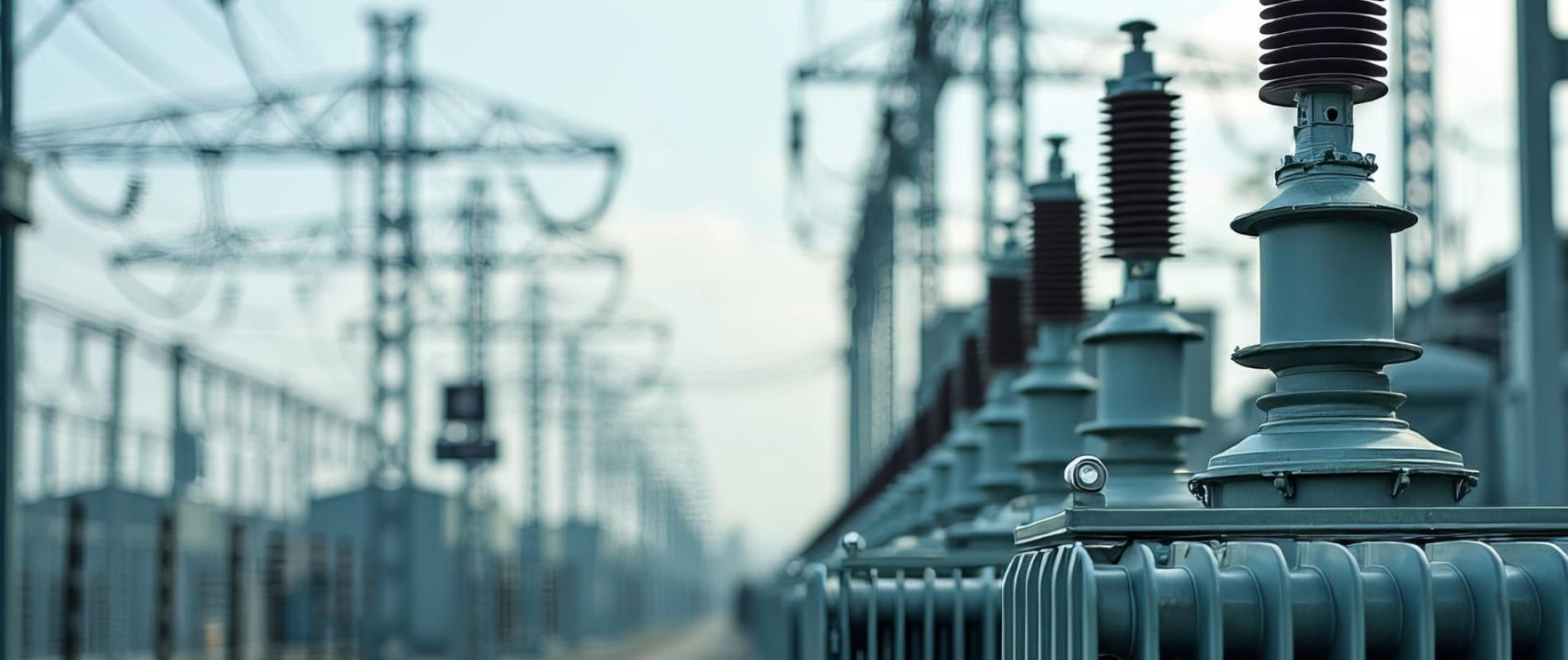
If you look up at a line of transformers or outdoor substation busbars, you will notice that the porcelain insulators are rarely standing completely straight up like flagpole pillars. Instead, they are often mounted leaning outward at a sharp angle.
Apprentices often wonder if the installation crew was just careless with their alignment tools. In reality, that tilt is engineered on purpose to solve two big natural problems: rainwater and high-voltage electricity.
Stopping rain from making a continuous water bridge
When a heavy rainstorm hits the equipment yard, water pours down over everything. If an insulator were standing perfectly vertical, the water would run straight down the sides in a long, continuous stream, like water running down a windowpane.
As we know, rainwater is not pure water—it picks up dust, salt, and dirt from the air. A continuous stream of dirty water running from the top live wire to the bottom steel base acts like a thin copper wire. Electricity will gladly follow that wet path straight down to the ground.
When the insulator is tilted at an angle, gravity forces the falling water to drip straight off the outer edges of the umbrella-like ridges (the sheds) instead of running down the main body. The water snaps into individual drops as it falls, breaking the continuous liquid path into harmless tiny pieces.
Keeping the underside of the sheds completely dry
The shape of the insulator is designed like a stack of tiny umbrellas. When you tilt the unit sideways, the underside of each ceramic skirt stays completely dry and shielded, even during a sideways wind and rainstorm.
Electricity cannot jump across the insulator easily if it encounters dry porcelain spots. By tilting the insulator, you guarantee that there are always dry gaps beneath the skirts. Those dry zones break up the electric arc, stopping a major flashover before it can start.
Another huge benefit of the tilted angle has to do with birds. As we discussed in earlier posts, birds love sitting on the top metal caps of insulators and leaving wet, conductive droppings right down the side.
If the insulator is vertical, the bird dropping slides straight down the porcelain body, leaving a thick, dirty streak that conducts electricity instantly.
When the unit is installed leaning outward, any dropping falls straight down through empty air, landing on the gravel ground below instead of smearing across the porcelain surface.
Finally, there is a mechanical reason for the angle. Power lines coming into the transformer don't just drop straight down from above; they pull sideways from distant poles.
If a heavy wire pulls on a vertical insulator from the side, it creates a massive bending force right at the bottom cement joint. Over time, that constant sideways tug will fatigue the metal cap or crack the porcelain.
By angling the insulator toward the incoming wire, the heavy tension pulls directly along the length of the porcelain body rather than snapping it sideways. This lets the tough compressive strength of the porcelain take the load safely for decades.



WeChat Official Account
+86-757-81230551
+86-18925992735
